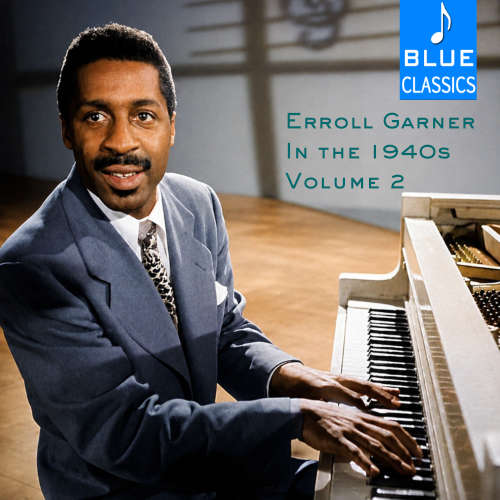
Title: ERROLL GARNER IN THE 1940S VOL 2
Year: 1949
Category: JAZZ,BLUECLASSICS,PIANO
- 1. Goodbye 02:57
- 2. A Cottage for Sale 02:53
- 3. I Don't Stand a Ghost of a Chance with You 02:38
- 4. I'm in the Mood for Love 02:55
- 5. Love Walked In 02:59
- 6. More than You Know 02:46
- 7. Undecided 02:43
- 8. Red Sails in the Sunset 02:43
- 9. All of Me 02:51
- 10. Over the Rainbow 03:03
- 11. Cherokee 06:19
- 12. This Can't Be Love 02:21
- 13. Moonglow 02:38
- 14. She's Funny That Way 02:32
- 15. Turquoise 02:51
- 16. Impressions 03:16
- 17. Blue and Sentimental 03:01
- 18. I Can't Give You Anything But Love 03:10
- 19. The Way You Look Tonight 03:10
- 20. Confessin' 02:56
- Erroll Garner – piano
John Levy – bass
George de Hart – drums
Red Callender – bass
Lou Singer – drums
Harold "Doc" West – drums
John Simmons – bass
John Levy – drums
Alvin Stoller – drums
Leonard Gaskin – bass
Charlie Smith – drums
Ulysses Livingston – guitar
Teddy Edwards – tenor saxophone
Chuck Thompson – drums
Dave Lambert – voice

ERROLL GARNER IN THE 1940S VOL 2
by Erroll Garner
Erroll Garner's recordings from the second half of the 1940s document a formative period in his career, as he moved from the New York club scene into a wider recording career and established a musical identity of his own.
Garner was born in Pittsburgh in 1921 and was largely self-taught as a pianist. He began playing at an early age and learned primarily by ear. He never learned to read conventional Western musical notation, a characteristic that remained part of his musical identity throughout his career. In 1944 he left Pittsburgh for New York, where he became involved in the city's active jazz scene and worked with bassist Slam Stewart's trio during 1944–45 before establishing himself as a solo performer and bandleader.
The earliest recordings represented here come from 1945, when Garner was already working in a variety of settings. His performances from this period include solo piano as well as trio recordings with different rhythm-section musicians. The September 25, 1945 session, for example, featured Garner with John Levy on bass and George De Hart on drums, producing recordings including “Laura,” “Stardust,” “Somebody Loves Me,” and “Back Home Again in Indiana.”
In 1946 Garner moved to Los Angeles. There he continued recording in small-group settings and became involved with Norman Granz's Jazz at the Philharmonic. His recording of “Laura” became an important early success, and in 1947 he recorded with Charlie Parker during the session that produced “Cool Blues.” At the time, Garner's playing combined elements of swing with an openness to the emerging language of bebop, without placing him neatly within either style.
The recordings from 1947 show this range particularly clearly. On February 19, Garner recorded in Los Angeles with George “Red” Callender on bass and Harold “Doc” West on drums, including his own composition “Pastel.” On June 10, he recorded a group of solo piano performances, among them “Play Piano Play,” “Love Is the Strangest Game,” “Blue Garni,” and “Don't Worry About Me.” These recordings were issued by Dial and later appeared in various compilations and reissues.
By the beginning of 1949, Garner was recording regularly in Los Angeles in trio settings. The sessions included both John Simmons and Alvin Stoller, as well as Leonard Gaskin and Charlie Smith on other dates. Recordings from March 29, 1949 included “September Song,” “All the Things You Are,” “Body and Soul,” “Stompin' at the Savoy,” and other standards. Other sessions from the year included solo piano performances and collaborations with larger ensembles.
During these years Garner was developing the characteristics that would remain central to his playing: a strong rhythmic foundation, melodic freedom, and an individual relationship between the two hands. His left hand could supply a steady rhythmic framework while the right hand moved more freely above it. His approach did not depend on a conventional written score; instead, he built performances through memory, listening, variation, and spontaneous invention.
By 1949, Garner had moved beyond the status of a local pianist. His growing recording career and performances had established him as a recognized figure in jazz. When he returned to New York later that year, he was already appearing as a headliner, and the period covered by these recordings had brought him from the New York club scene of the mid-1940s to a broader national career.
The recordings gathered in these two volumes follow that development through a succession of solo performances, trios, and different recording settings. Together, they document Garner's musical activity during the years in which his distinctive piano style was taking shape.
EU Public Domain Notice
The historical sound recordings included in this release are in the public domain in the European Union. Blue Music Group has created a new digital restoration and mastering of these historical recordings. The digital restoration and mastering by Blue Music Group are protected by applicable copyright and related rights. Rights may differ in other territories, including the United States. This release is not intended for distribution in the United States.
Cover artwork: The original photographic image has been legally assessed as being in the public domain in the EU following the expiry of the applicable 50-year term under Section 49a. The image has been restored, enhanced and colorized by Blue Music Group. © Blue Music Group. All rights reserved.